24/7 Emergency IICRC S500 Structural Drying Guide: Psychrometrics & Moisture Science
IICRC S500 structural drying utilizes scientific psychrometric calculations to lower ambient vapor pressure, drawing bound moisture from saturated framing lumber and concrete slabs. Certified restoration technicians deploy commercial LGR dehumidifiers and high-velocity air movers to achieve certified dry equilibrium standards efficiently.
Understanding the thermodynamic science and procedural standards of water damage restoration empowers homeowners to make informed mitigation decisions. Our network connects callers with IICRC certified professionals equipped to handle complex drying projects.
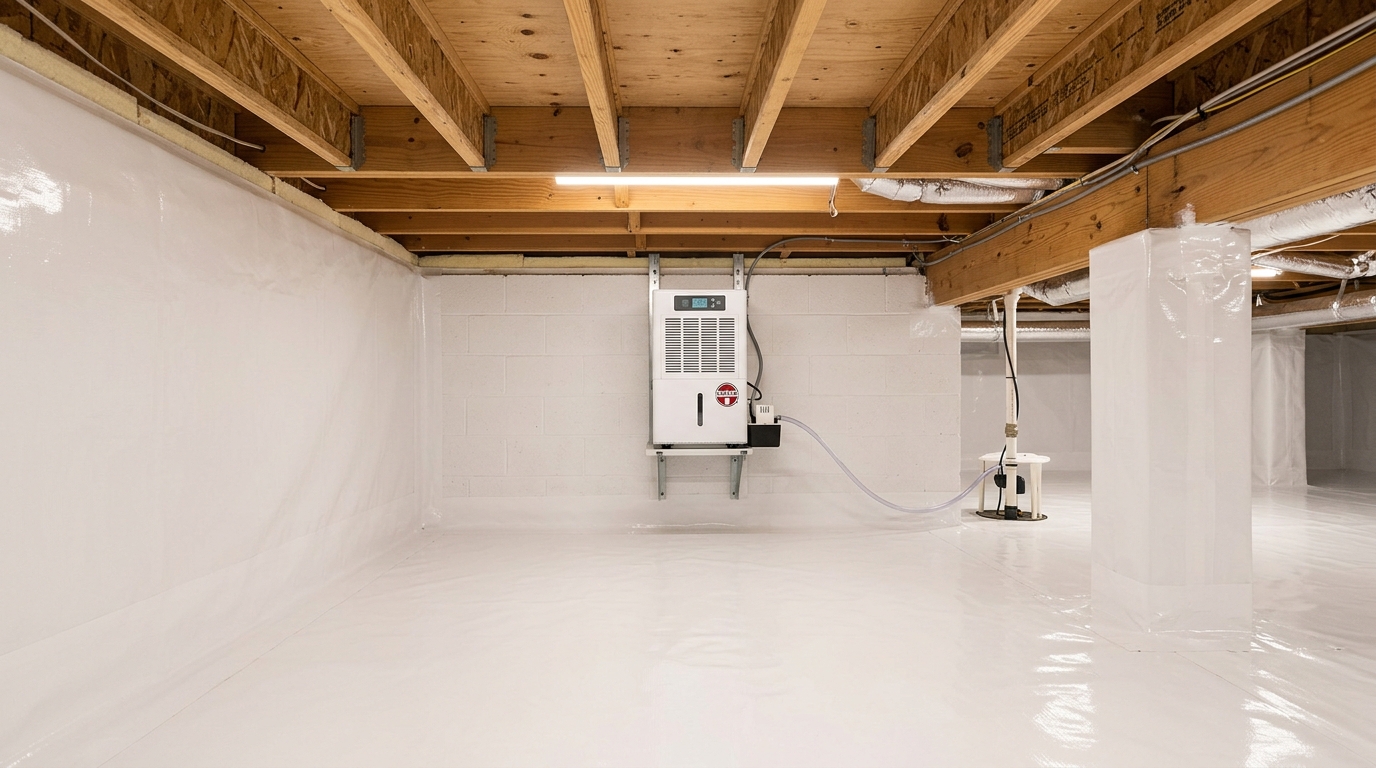
Thermodynamic Principles of Psychrometric Moisture Removal
Structural drying is an applied science governing the behavior of moisture vapor in air and solid building assemblies. Certified technicians manipulate indoor temperature, relative humidity, and air velocity to maximize vapor pressure differentials between wet building materials and surrounding ambient air.
Vapor Pressure Gradients & Capillary Desorption
Trapped water naturally migrates from areas of high vapor pressure inside saturated wood studs toward areas of lower ambient vapor pressure. By operating industrial dehumidifiers to depress indoor humidity, technicians create a steep gradient that accelerates continuous moisture desorption from deep inside structural framing.
Without adequate vapor pressure control, surface materials dry prematurely while core framing remains wet. This unbalanced state leads to structural rot.
Specific Humidity & Grains Per Pound (GPP) Calculations
Relative humidity percentages fluctuate with temperature changes, making them unreliable for tracking absolute moisture extraction. Restoration specialists calculate specific humidity in Grains Per Pound of dry air, using digital thermo-hygrometers to verify that daily grain depression exceeds target drying benchmarks.
Lowering indoor GPP below thirty-four grains enables deep low-humidity drying. Daily readings are documented on psychrometric drying logs for insurance verification.
Low-Grain Refrigerant (LGR) vs Desiccant Dehumidifiers
Selecting appropriate commercial dehumidification equipment depends upon building construction types, ambient temperatures, and the volume of trapped structural water. Restoration contractors deploy Low-Grain Refrigerant units for standard residential structures and desiccant trailers for dense concrete or cold climates.
LGR Dehumidifier Pre-Cooling Heat Pipes & Efficiency
Low-Grain Refrigerant dehumidifiers utilize internal air-to-air heat exchangers to pre-cool incoming humid air before it contacts refrigerated coils. This internal thermal exchange allows LGR units to condense moisture down to thirty percent relative humidity, far outperforming standard residential dehumidifiers.
LGR machines remove up to thirty gallons of water daily under extreme conditions. Built-in purge pumps discharge water automatically through plumbing fixtures.
Industrial Silica Gel Desiccant Rotor Systems
When water saturates dense concrete foundation slabs, plaster walls, or sub-freezing building environments, desiccant dehumidifiers provide superior drying performance. Desiccant units use chemical silica gel rotors to absorb moisture directly without requiring condensation, producing ultra-dry air streams.
Desiccant trailers operate effectively in cold winter temperatures below fifty degrees Fahrenheit. Continuous dry air circulation prevents secondary concrete foundation cracking.
Laminar Airflow Positioning & Boundary Layer Disruption
A micro-thin boundary layer of cool, moisture-saturated air naturally rests against wet floors and walls, slowing down evaporative drying rates significantly. Technicians place high-velocity axial air movers at calculated perimeter angles to displace this stagnant layer and drive continuous surface evaporation.
Vortex Airflow Patterns Across Perimeter Walls
Positioning commercial air movers at thirty to forty-five-degree angles along room perimeters generates a continuous cyclonic airflow vortex. This uniform air movement sweeps across baseboards, subfloors, and framing lumber simultaneously, ensuring consistent evaporation without leaving stagnant dead zones.
IICRC S500 guidelines determine air mover quantities based on wall perimeter footage. Proper placement prevents localized condensation and accelerates overall drying momentum.
Specialized Cavity Injectidry Air Distribution
Trapped moisture inside enclosed wall cavities cannot dry efficiently through standard room airflow alone. Restoration technicians deploy injectidry systems that pump pressurized dry heated air through tiny holes drilled behind baseboards directly into wet stud bays.
Direct cavity ventilation dries framing lumber without requiring extensive sheetrock demolition. Baseboards are reinstalled neatly once certified dry standards are achieved.
Documenting Certified Dry Standards & Moisture Equilibrium
Structural drying is never completed based on visual observation or surface touch alone. Restoration contractors record rigorous daily measurements using calibrated pin meters, non-destructive moisture scanners, and thermo-hygrometers until building components match documented pre-loss baseline standards.
Unaffected Room Baseline Reference Standards
Technicians establish dry standard targets upon arrival by testing unaffected structural framing, subflooring, and sheetrock in dry areas of the building. These measured percentages establish the authentic equilibrium moisture content benchmark for the entire restoration project.
Drying to natural local baselines prevents both incomplete moisture removal and excessive over-drying. Structural framing retains its natural flexibility and structural integrity.
Certified Completion Documentation & Adjuster Sign-Off
When all affected structural components test within two to four percent of baseline moisture content for two consecutive inspection days, equipment is safely deactivated. Technicians generate certified moisture completion certificates providing legal documentation for insurance claim settlement.
Property owners receive comprehensive psychrometric drying records for permanent home files. Certified documentation guarantees a safe, structurally sound, and mold-free living environment.
Frequently Asked Questions About IICRC S500 Structural Drying Guide: Psychrometrics & Moisture Science
Review authoritative answers to common homeowner questions regarding restoration equipment, psychrometric calculations, IICRC standards, and insurance claim coverage.
Psychrometric drying is the science of manipulating indoor air temperature, relative humidity, and airflow velocity to l...
Psychrometric drying is the science of manipulating indoor air temperature, relative humidity, and airflow velocity to lower vapor pressure, which forces bound moisture out of structural materials into the air stream for condensation.
Grains Per Pound (GPP) measures the exact weight of water vapor in air regardless of temperature, whereas relative humid...
Grains Per Pound (GPP) measures the exact weight of water vapor in air regardless of temperature, whereas relative humidity fluctuates with temperature. Lowering GPP guarantees continuous structural moisture removal.
LGR dehumidifiers typically run 24 hours a day for 3 to 5 consecutive days. Continuous operation maintains low vapor pre...
LGR dehumidifiers typically run 24 hours a day for 3 to 5 consecutive days. Continuous operation maintains low vapor pressure and prevents relative humidity rebounds that trigger secondary mold growth.
Stopping structural drying before reaching documented dry equilibrium traps moisture deep inside framing lumber and subf...
Stopping structural drying before reaching documented dry equilibrium traps moisture deep inside framing lumber and subfloors, causing hardwood buckling, drywall sagging, and toxic mold spore amplification.
Call our 24/7 emergency referral hotline now to check on-call restoration capacity in your local municipal area.
📞 CALL (855) 716-3231