Can Hardwood Floors Be Saved After Water Damage?
Hardwood floors can often be saved after water damage if emergency mitigation begins within twenty-four to forty-eight hours of clean water exposure. Independent restoration contractors deploy specialized negative air vacuum mat systems to extract trapped subfloor moisture without tearing up delicate hardwood planks.
Our field restoration engineering network answers critical questions regarding emergency structural drying, insurance claim line items, and IICRC S500 procedural standards to assist homeowners facing indoor water crises.
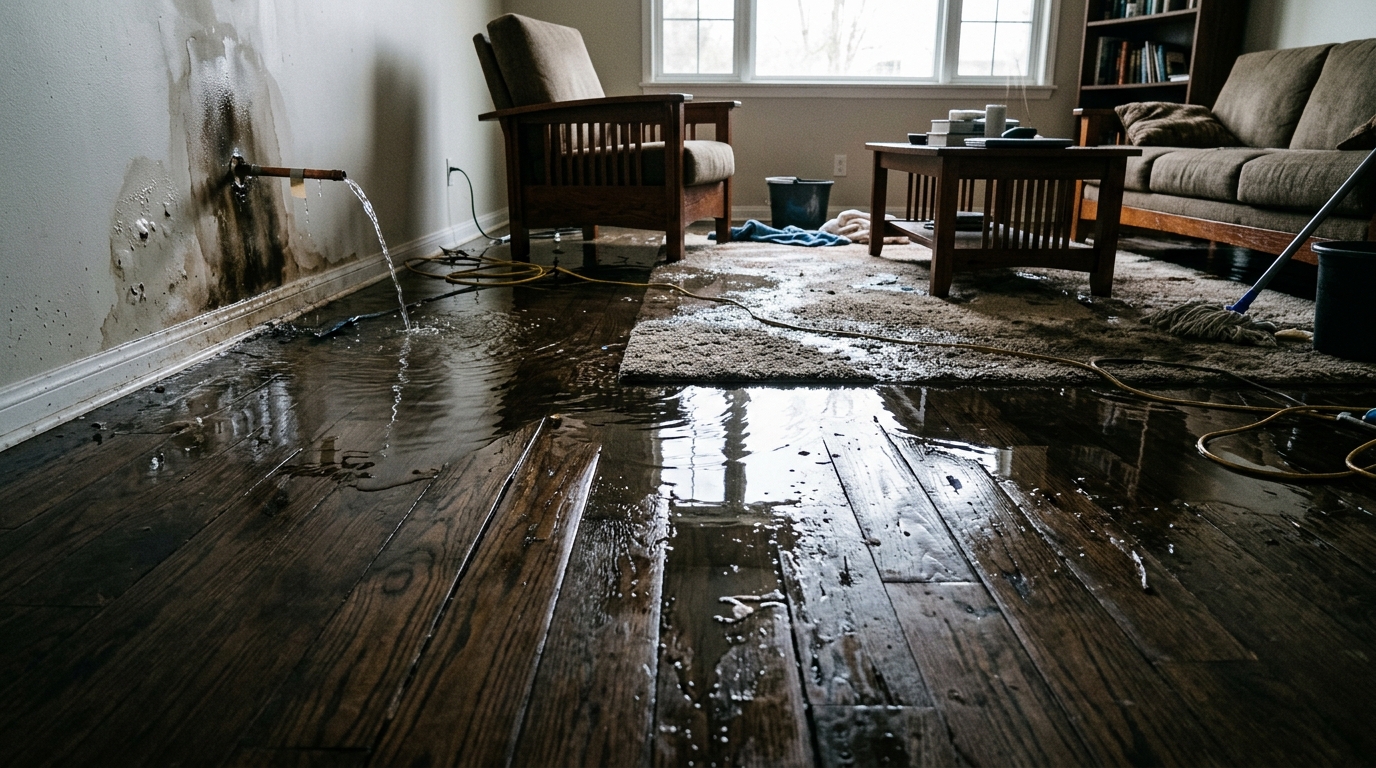
Wood Moisture Dynamics: Cupping, Crowning & Saturation
Solid hardwood planks are porous organic hygroscopic materials that absorb moisture vapor and liquid water through cellular micro-structures. Understanding how wood expands and contracts determines whether saturated floorboards can be dried and restored successfully.
Why Hardwood Planks Cup Upward at the Edges
When water pools beneath finished hardwood flooring, the unsealed underside of planks absorbs moisture while the top polyurethane finish resists absorption. This unequal moisture distribution forces bottom wood cells to expand, curling plank edges upward into unsightly concave cups.
Cupping indicates high moisture trapped in the subfloor. Specialized drying mats reverse cupping without requiring destructive floor demolition.
The Critical Mistake of Premature Floor Sanding
Homeowners who sand down cupped hardwood floor edges before the underlying subfloor is completely dry ruin their floors permanently. Once the subfloor eventually dries and plank bottoms shrink, sanded edges become thinner than center cores, creating irreversible convex crowning.
Never sand wet or cupped hardwood floors. Floors must achieve certified dry equilibrium before any cosmetic refinishing is considered.
Specialized Hardwood Vacuum Drying Mat Systems
Standard room air movers cannot pull trapped moisture out from beneath tightly fitted tongue-and-groove hardwood planks. Restoration specialists deploy specialized injectidry vacuum mat systems that seal directly over floorboard seams to extract subfloor vapor.
High-Pressure Negative Vacuum Suction Across Planks
Commercial vacuum mat systems feature heavy polyurethane panels taped securely over wet hardwood floor sections. High-pressure vacuum blowers draw negative air pressure through floorboard seams, pulling trapped water vapor out from underlying plywood subfloors continuously.
Vacuum mats operate alongside commercial LGR dehumidifiers. Continuous vapor extraction straightens cupped floorboards as wood achieves uniform moisture equilibrium.
Subfloor Cavity Drying from Basements & Crawlspaces
When hardwood floors are installed over accessible basement ceilings or crawlspaces, technicians position high-velocity air movers underneath the subfloor joists. Drying subfloor plywood from below accelerates total evaporation and prevents floor delamination.
Dual-sided drying stabilizes hardwood floor assemblies rapidly. Technicians monitor wood moisture percentages daily to guide equipment positioning.
Category Purity & Flooring Salvage Feasibility
Whether wet hardwood flooring can be salvaged depends heavily upon the purity classification of incoming water. Category 1 clean water allows complete structural salvage, whereas Category 3 sewage water mandates full floor tear-out for health safety.
Category 1 Clean Water: Excellent Salvage Probability
Water originating from clean domestic plumbing lines, broken refrigerator ice maker lines, or leaking water heaters carries no biological pathogens. When extracted within forty-eight hours, over eighty percent of solid oak, maple, and walnut hardwood floors can be restored completely.
Fast contractor mobilization preserves valuable antique and custom hardwood floors. Homeowners avoid thousands in floor replacement costs.
Category 3 Black Water: Mandatory Floor Replacement
Overland river floodwaters and sewage backups contaminate porous wood grain with fecal bacteria, viral pathogens, and toxic silt. Saturated hardwood planks cannot be effectively sanitized and must be removed and discarded under IICRC S500 guidelines.
Concrete slab subfloors are scrubbed with hospital-grade EPA antimicrobials. Certified decontamination ensures safe conditions before installing new flooring.
Solid Hardwood vs Engineered Flooring Salvage Limits
The physical construction of your flooring material significantly affects salvage feasibility during a water damage emergency. Solid hardwood planks possess substantial drying resilience, whereas engineered wood and laminate flooring have distinct structural limitations.
Solid Oak, Maple & Walnut Resilience
Solid hardwood flooring consists of solid timber planks that expand and contract naturally without internal adhesive failure. Because solid wood contains no glue layers, specialized vacuum drying mats can dry solid planks back to original flat dimensions.
Solid hardwood can be sanded and refinished multiple times after drying. Historic hardwood floors retain their original strength and beauty.
Engineered Wood Delamination & Laminate Swelling
Engineered wood flooring features thin hardwood veneers bonded over composite plywood layers. Prolonged water exposure dissolves internal glues, causing veneer peeling and permanent delamination that cannot be reversed by drying equipment.
Laminate flooring made from pressed wood fiber swells permanently upon water contact and must be replaced. Technicians evaluate flooring construction upon arrival.
The save-or-replace decision rests on moisture readings, not on hope
A cupped solid-hardwood floor can sometimes relax after a controlled drying program and then be refinished. A floor that has tented, a board that has delaminated, an engineered floor with a worn-through face, or a swollen particleboard underlayment is usually a replacement, at least in the affected area. The decision should come after drying and after comparison readings against a dry room, not on the day the water is extracted. hardwood-floor drying is the service referral; the repair guide is the sequence.
Sewage and untreated floodwater make 'save the floor' a shorter conversation, because contamination, not only movement, is the issue. Category 1, 2, and 3 water explains why.
What you should do while that decision is open
Stop the leak, towel standing water, remove rugs, photograph joints, and Call (855) 716-3231 and give the ZIP of the house that is wet. Do not sand a still-wet floor. EPA's 24-48 hour window is a mold goal for the wood and the underside; a professional drying plan is what makes a later save possible. Ask whether the contractor works to IICRC S500. This referral network is not IICRC-certified as a firm. FloodSmart's flood-exclusion applies if the water was flooding. Related: cost factors and subfloor work.
A second look at engineered floors, and at floors over a wet crawl space
Engineered floors often have a thin wear layer. Even when they flatten after drying, there may not be enough wood to sand. A crawl space that is still wet will cup a 'saved' floor again. Those two facts are why a save decision is not only about the face of the board. Ask for underside or crawl-space readings. Call (855) 716-3231 and give the ZIP of the house that is wet. Related: hardwood-floor drying and crawl-space work.
When only part of a floor can be saved
Sometimes a room can be refinished and a closet or a hallway has to be replaced. That mixed outcome needs a product-match plan, or an honest visible seam. Ask for that plan before anyone demolishes the whole floor 'to be safe,' and before anyone promises a seamless save. Call (855) 716-3231 and give the ZIP of the house that is wet. Related: cost factors.
Regulatory Sources & Technical References
Remediation timelines, moisture safety thresholds, and insurance recovery guidelines cited across this guide reference official federal agency publications and ANSI-accredited restoration standards.
"A Brief Guide to Mold, Moisture and Your Home" - Documents the critical 24 to 48-hour structural drying window to prevent microbial amplification, safe residential cleanup thresholds for areas under 10 square feet, and cautions against routine bleach usage without source moisture elimination.
View Official EPA Guidance →"Mold Cleanup in Your Home" - Comprehensive federal protocols covering personal protective equipment, containment barriers, and building material remediation procedures.
View EPA Mold Cleanup Protocols →Defines statutory boundaries between standard private homeowners policies and federal flood coverage, outlining structural building coverage, contents protection, and sewer backup riders directly caused by overland flooding.
Visit FloodSmart.gov →"Standard for Professional Water Damage Restoration" - The recognized technical reference defining Category 1 (clean), Category 2 (gray), and Category 3 (black) water classifications, psychrometric drying formulas, and structural moisture verification metrics.
This referral network operates as an independent matching service and holds no corporate IICRC certifications. Property owners should verify current individual technician certifications directly with dispatch contractors.
Frequently Asked Questions: Can Hardwood Floors Be Saved After Water Damage?
Review authoritative answers to common homeowner questions regarding restoration timelines, equipment operation, and insurance documentation.
Yes. If dried properly using specialized vacuum mat systems before permanent wood cell deformation occurs, cupped hardwo...
Yes. If dried properly using specialized vacuum mat systems before permanent wood cell deformation occurs, cupped hardwood floor planks will flatten out as subfloor moisture reaches dry equilibrium.
No. Never sand cupped hardwood floors while they are wet. Once the subfloor completely dries, planks shrink back down, a...
No. Never sand cupped hardwood floors while they are wet. Once the subfloor completely dries, planks shrink back down, and sanded edges will become sunken crowns requiring complete replacement.
Engineered wood can only be saved if water is extracted immediately. Extended moisture exposure dissolves internal adhes...
Engineered wood can only be saved if water is extracted immediately. Extended moisture exposure dissolves internal adhesives, causing permanent veneer delamination and board buckling.
Technicians place specialized vacuum floor panels over floorboard seams and run negative pressure vacuum blowers that pu...
Technicians place specialized vacuum floor panels over floorboard seams and run negative pressure vacuum blowers that pull trapped subfloor moisture out through the wood grain non-destructively.
Call our 24/7 emergency referral hotline now to check on-call restoration capacity in your local municipal area.
📞 CALL (855) 716-3231